
Open Bars, Hidden Costs: What Visible Coffee Production Demands from Operators
Watching a coffee being made has become part of the product that customers purchase in coffee shops. The process provides credible signals: quality that is easier to see, a wait that is easier to understand, and a clean workflow that is easier to trust.
But the same visibility can also magnify inconsistencies: a remake pushed aside, a dirty steam wand, or a backlog of orders that leads to a chaotic workflow. The open bar has made coffee craft visible, but it has also turned the operation itself into a product.
Knowing which parts of production customers should see and what those moments communicate matters in Canada.
Coffee consumption remains deeply habitual, but spending is becoming more selective: the Coffee Association of Canada (CAC) reported in its Winter 2025 study that 71% of Canadian adults had consumed a coffee beverage the previous day. Yet eight in ten had noticed higher coffee prices, and 21% said they had reduced out-of-home coffee spending.[1] Meanwhile, at-home coffee preparation accounts for roughly 68% of total coffee occasions nationwide, supported by premium home espresso setups and quality whole-bean subscriptions. Customers have not abandoned coffee, but many are scrutinizing where a purchased cup earns its premium.
Operators must offer a distinct value proposition that a kitchen counter cannot reproduce. Treating an open bar simply as an interior design feature or a boutique brewing method might increase costs without increasing brand value.
Conflicting roles modern open bars have to play
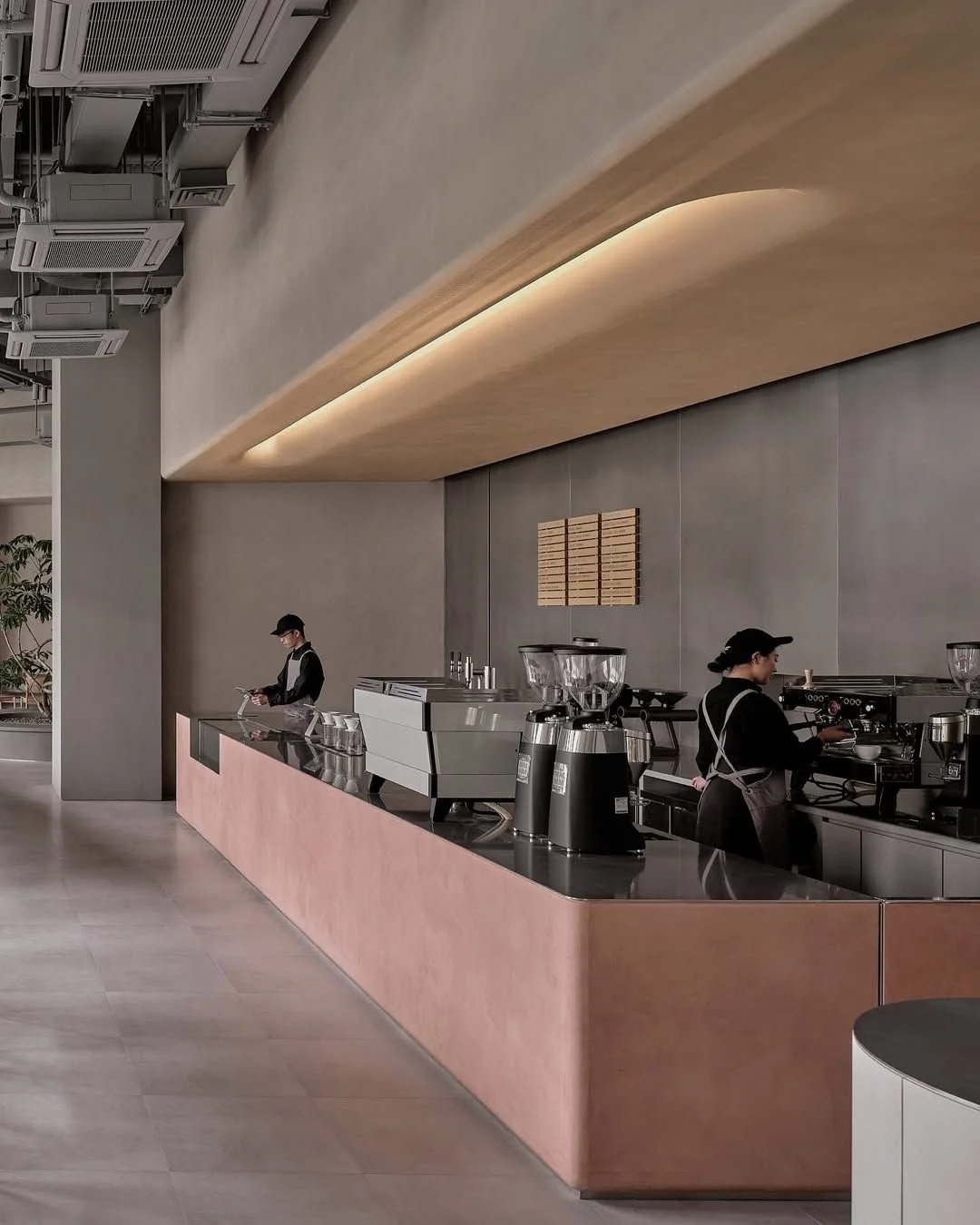
The original “open bar” model of specialty coffee was designed for a low-volume environment that prioritizes product customization and interaction. Modern open bars, however, need to replicate that visual aesthetic while behaving like a high-throughput production line and dispatch centre for multiple order channels.
Starbucks’ 2025 redesign illustrates the separation required. The company called its espresso bar a “front-row seat” to beverage craft, while adding pickup risers and open space to reduce congestion between customers who were staying and those collecting mobile orders.[2] Visibility and flow are different design problems. Opening the bar solves only the first.
Transparency raises the standard of execution and management
An open bar does not inherently guarantee cleanliness. It raises the standard of execution and management: restocking, wiping, remakes, and waste handling now occur in public view. Visibility can strengthen trust when the operation is disciplined. It can also magnify an ordinary lapse into evidence of weak management.
An occasional stained cloth, used tools, or waste waiting to be removed can become part of the brand impression and directly influence revisit rates. An open bar must maintain visual order and remain brand-ready throughout service, even during the rush.
The hidden complexity behind open-bar operations
Baristas working at open bars must combine beverage technique, order sequencing, customer communication, visible hygiene, and service recovery. For independent coffee shops, it is difficult to recruit and retain qualified baristas. Data show that the annual churn rate for café baristas in 2026 is approximately 70%–100%, with retraining after turnover costing around $5,000 per employee.[9] Beyond labour shortages and high costs, maintaining standards across people, shifts, and locations is another drain on profits. Starbucks reported a US$500 million investment in Green Apron Service for scheduling, standardized training, and additional partner hours.[4][5] This shows the infrastructure behind a simple service promise.
Starbucks Canada addressed the complexity by reducing its menu by roughly 20%, linking simplification to shorter waits, better quality, and greater consistency.[6] Even a mature chain can place more demands on its production model than the model can reliably handle.

Seeing work is not the same as understanding progress
Apparent simplicity often requires more planning and back-of-house support. People might see an artisanal brewing method without understanding it, but smart queue logic, a clear service routine, and a separate pickup zone are easier to recognize as signs of a coffee brand’s reliable service promise.
When scheduling remains invisible, a rational workflow can be perceived as chaotic or unfair. Customers can see that employees are busy at an open bar, but they may not understand why someone who arrives later receives a drink first or how long the queue will take.
Making scheduling visible is something coffee shop operators should not ignore when building trust with customers. A good open bar requires much more system design than attractive renderings alone. Test the layout against operational requirements: clear order states, separation between ordering and pickup, clear sequencing logic across channels, and a way to resolve exceptions without stopping the main queue.
Choose the degree of openness
There is no universal format. Based on order volume and workflow complexity, however, coffee shops can generally be grouped into four categories.

Workflow complexity depends on the level of customization in the coffee menu and drink-preparation process. Many specialty coffee shops, such as Blue Bottle and %Arabica, fall into the high-volume, low-complexity segment because every drink follows nearly identical steps. This segment is also where automation creates the most value.
The real design question is: Which steps should the customer see, and which must be standardized, separated or screened so the visible experience remains credible?
Robotics changes the operating architecture
Adding one automated device to a fragmented manual workflow does not necessarily remove labour or complexity. Starbucks stated in its FY2025 second-quarter call that its assumption that automated equipment could offset labour reductions had not played out. This shows that isolated automated equipment cannot eliminate the human tasks and queue problems left around it.
Unimate’s commercial-grade coffee robotics represent a different proposition when orders, scheduling, production, equipment status, cleaning, and exception recovery are integrated into one system. The goal is to help coffee shop operators deliver on the daily promise that the operation is ready to be seen, while minimizing costs, skill barriers, and uncertainty.
Research note and sources
No robust 2025–2026 study was identified that isolates an open bar’s labour-cost premium or sales effect. This article distinguishes reported facts from operating inferences.
1. Coffee Association of Canada, "Coffee Consumption Remained Strong in Canada in 2025, Despite Rising Prices" and Canadian Coffee Consumption 2025 infographic, February 17, 2026.
2. Starbucks, "Starbucks coffeehouse designs enter a new era," September 5, 2025.
3. City of Toronto, "Food Safety Posters & Templates," modified December 2, 2025.
4. Starbucks, "Message from Brian: Green Apron Service, one month in," September 8, 2025.
5. Starbucks, "Starbucks investments in coffeehouse partners are paying off," April 29, 2026.
6. Starbucks Canada, "Simplifying our menu for a better Starbucks Experience," February 24, 2025.
7. Specialty Coffee Association, "Announcing the Winners of the 2026 Coffee Design Awards in San Diego," April 11, 2026.
8. Starbucks, FY2025 Q2 corrected earnings-call transcript, April 29, 2025.
9. Nowsta, "Restaurant Turnover Rates | Real Cost of Losing Staff," February 24, 2026.